
Taxiphote
Region: France Period: 1890–1930 Tag: Richard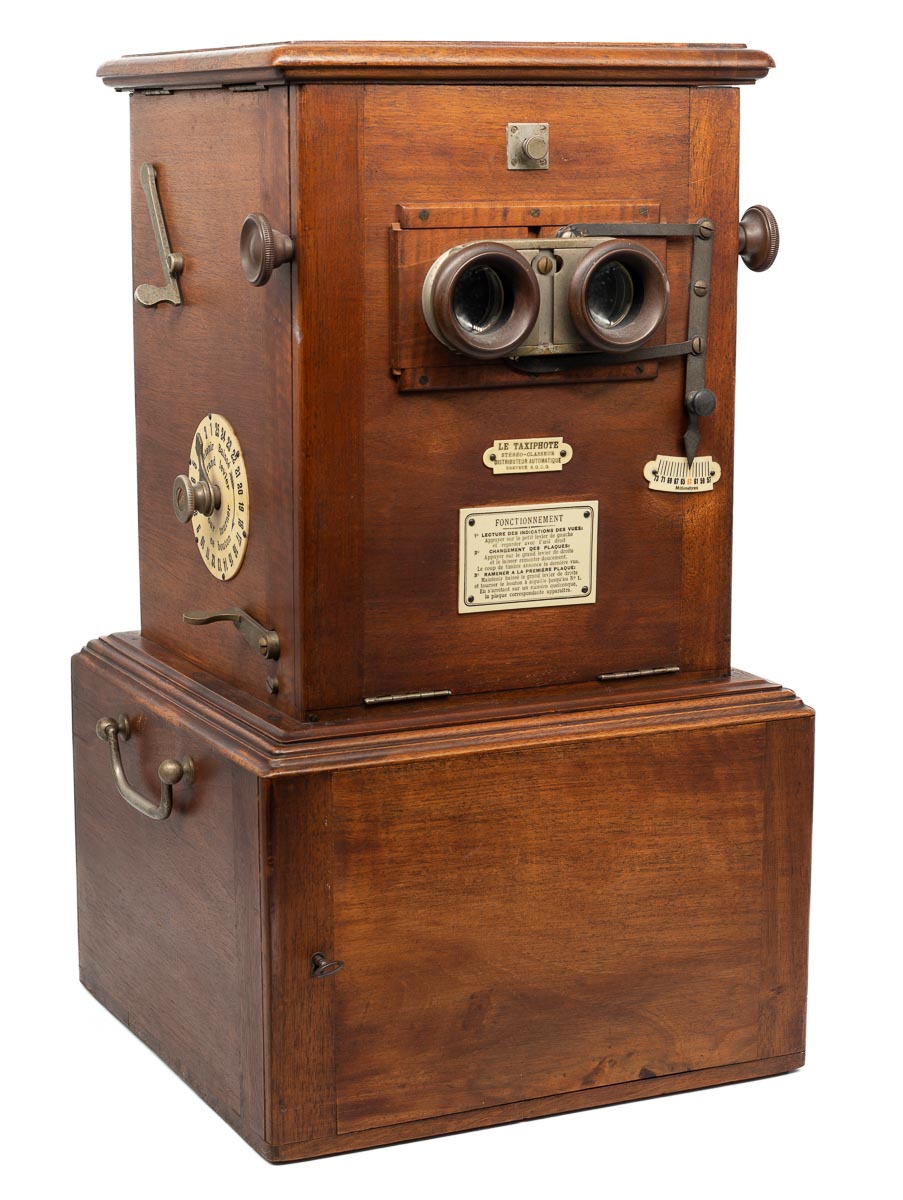
© Stereoscopy History
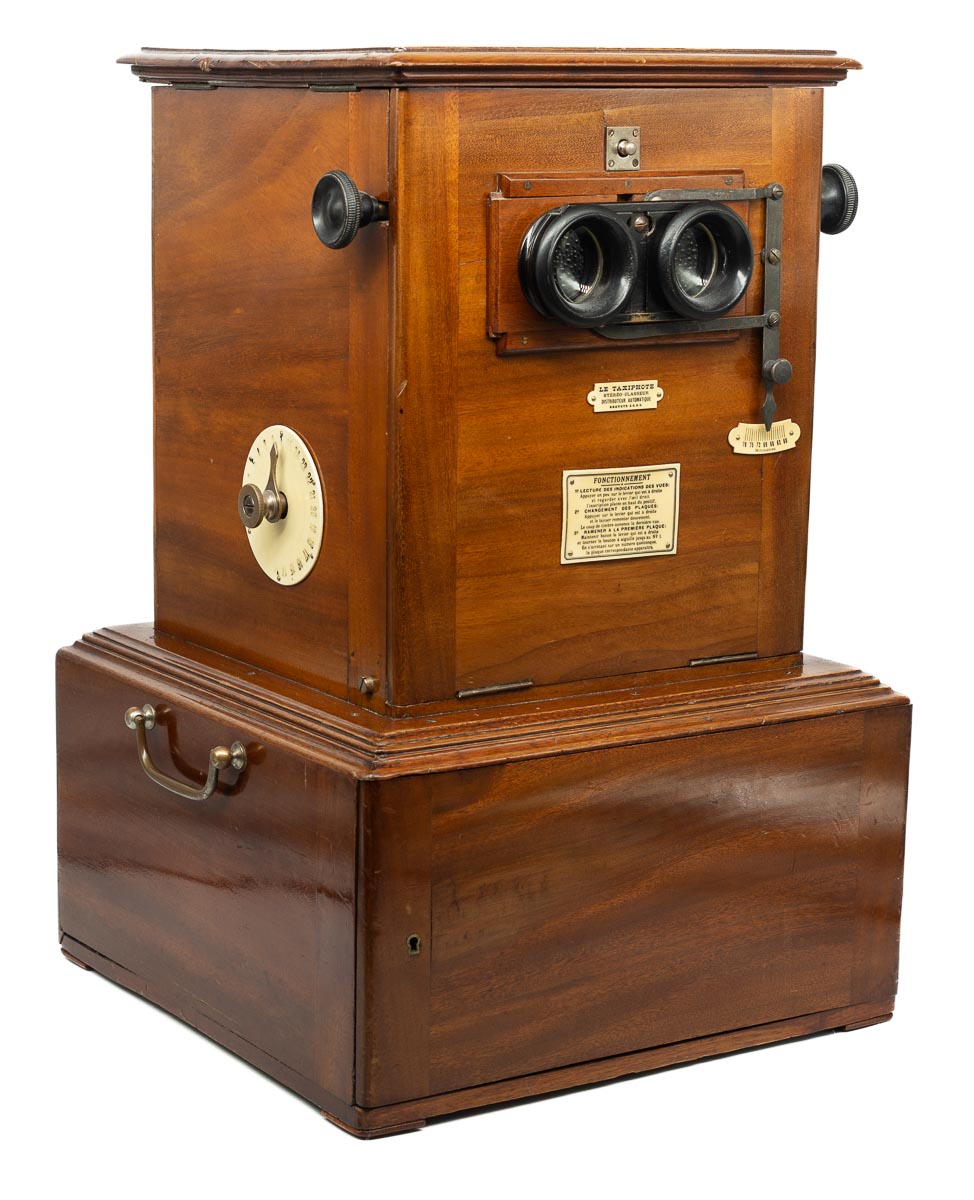
The Taxiphote was the first tray-based stereoscope for glass stereoviews. The viewer consists of a mechanical unit and cabinet for storing slide trays. The Taxiphote served as a model for a whole new range of similar stereoscopes that were produced in France and Germany until the 1930s.
Operation:
The front panel of the viewer can be opened. A slide tray is placed onto a metal carriage inside the viewer. After the panel is closed, a lever on the right-hand side is pressed downward. Two metal fingers beneath the tray rise upward, lift a glass plate from the tray, and position it in front of the lenses. When the lever is pressed downward again, the plate is returned to the tray and the carriage is advanced, after which the metal fingers raise the next image from the tray.
On the left-hand side, a circular index plate is mounted, displaying the number of the selected image. In the centre there is a rotary knob. When the lever on the right-hand side is pressed down and held in position, the rotary knob can be used to advance the tray rapidly to a specific number.
Models:
The standard Taxiphote was available in four models with type designations related to the format:
Taxiphote Normal or Foyer Moyen (45 x 107)
Taxiphote No. 1 (7 x 13)
Taxiphote No. 1bis (6 x 13)
Taxiphote No. 2 (8.5 x 17).
A limitation of the original design is the long distance between a slide and the lenses, which reduces the viewing experience for the small 45 x 107 format. Improved models addressed this issue:
Modèle Mécanique
The Modèle Mécanique moves slides both vertically and horizontally towards the lenses.
Modèle Optique
The Modèle Optique uses additional lenses to enlarge the image at the cost of slight image distortion and cropping.
Specifications:
Timeline:
1899
First patent of a tray-based mechanism.
1900
Introduction of the Stéréo-Classeur, the predecessor of the Taxiphote.
c. 1901
The name Taxiphote becomes common.
1903
Introduction Taxiphote for the formats 6 x 13 and 8.5 x 17.
1904
Introduction Taxiphote for the 7 x 13 format.
1904
The Taxiphote supports ocular adjustment.
1905
Patents filed for the mechanism of the Taxiphote Modèle Mécanique.
1908
Introduction of the Taxiphote Modèle simplifié.
1913
Redresseurs for autochromes become available.
Patents and registrations:
Number: 285184
Système d'appareil distributeur automatique des vues photographiques applicable aux stéréoscopes, appareils de projection, etc.
Filing: 21-01-1899, Applicant(s): Jules Richard, Louis-Joseph-Emmanuel Colardeau. via: archives.inpi.fr
Number: 293459
Système perfectionné d'appareil classeur distributeur automatique de vues photographiques applicable aux stéréoscopes, appareils de projection, etc.
Filing: 18-10-1899, Applicant(s): Jules Richard, Louis-Joseph-Emmanuel Colardeau. via: archives.inpi.fr
Further reading:
- Wing, Paul. Stereoscopes: The first one hundred years (1996) , pp. 174-180
- Martiné, Pascal. "Le Taxiphote - The most famous French stereo viewer" in: Stereosite (2 May 2021) . via: stereosite.com
© Stereoscopy History